




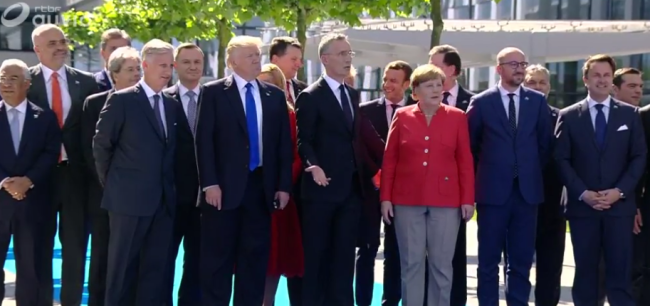
New Appointments Give Clues on Trump's European Policy: Wess Mitchell nominated for Assistant Secretary of State for European and Eurasian Affairs
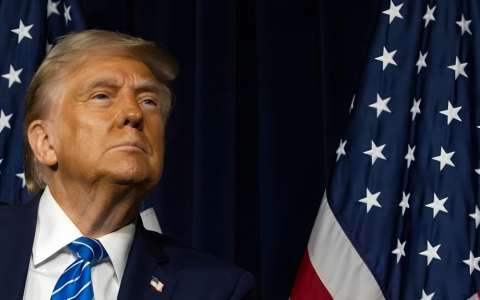
Benjamin Haddad, research fellow at Hudson Institute in Washington D.C., reviews Wess Mitchell’s nomination for Assistant Secretary of State for European and Eurasian affairs. According to Haddad, as U.S. President Donald Trump struggles to appoint leaders to his administration, Wess Mitchell, who awaits the U.S. Senate’s confirmation, could be a wise choice.

RAMSES 2018. Will the Information War Take Place?
RAMSES 2018. Will the Information War Take Place?, written by Ifri's research team and external experts, offers an in-depth and up-to-date analysis of global geopolitics.
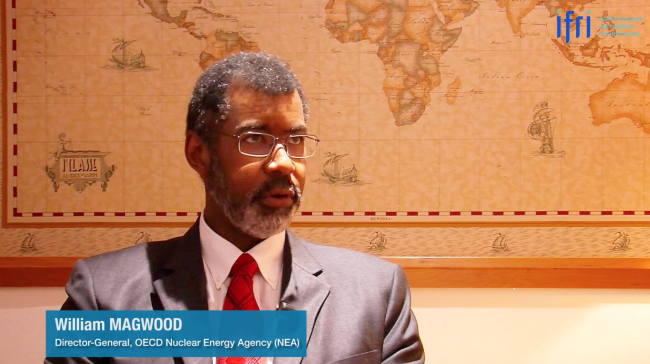
Nuclear Energy in the United States: an Appraisal
An interview with William D. Magwood, IV, Director-General of the OECD Agency for Nuclear Energy
Donald Trump's challenge to American democracy and the western alliance
On April 27, 2017, Ifri hosted David FRUM (former speechwriter for President George W. Bush, senior editor for The Atlantic magazine) to discuss Donald Trump's challenge to American democracy and the western alliance.

Trump and the Crisis of American Democracy
Trump’s victory in the 2016 presidential election is an expression of the crisis of American democracy.

Democratic Deconstructions
Today’s democratic governments appear less legitimate and their longevity less assured than ever.

Allies Fear Trump Is Eroding America’s Moral Authority
PARIS — When the State Department released its annual human rights report last week, it contained many of the usual tough American judgments of other countries. Iran was criticized for restricting freedom of religion and the media; Russia for discriminating against minorities; Eritrea for using torture; Bulgaria for violence against migrants and asylum seekers. The list went on.
Siloviki: What Influence on Russia's Domestic and Foreign Policy?
3 questions to Mark GALEOTTI, Senior Researcher at the Institute of International Relations Prague, Director of Mayak Intelligence consultancy.
What evolution of US-Russia relationship after Trump’s election? An American point of view
3 questions to Stephen SZABO, Executive Director, Transatlantic Academy.
What evolution of US-Russia relationship after Trump’s election? A Russian point of view
3 questions to Andrey KORTUNOV, Director General of the Russian International Affairs Council (RIAC).
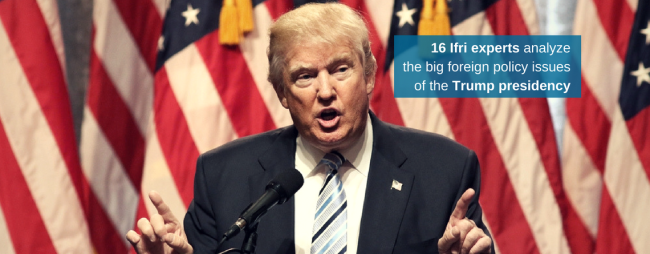
Le monde selon Trump. Anticiper la nouvelle politique étrangère américaine
What will become of US foreign policy under Donald Trump? A selection of Ifri researchers has come together to offer their thoughts on this question. Our experts cover an array of topics through 14 contributions, ranging from the future Sino-American relations, through US engagement in the Middle East, to the prospects of a renewed transatlantic relationship. This analysis intends to help readers anticipate the outcomes of this election in order to facilitate decision-making.
America First… and Europe Last? What will the Trump Presidency mean for Europe
After the audacity of hope, the rage of hopelessness has thus propelled Donald Trump to the White House. In a tamed but still tragic repetition of history, the economic crisis of 2008 has eventually produced its eventual political outcome, embodied in a farcical show-businessman who proudly cultivates contempt for the liberal institutions of Washington while supporting the authoritarian politics of Moscow. The consequences of this Trump moment will be profound for America, they may be even more crucial for Europe. That American elections are a global phenomenon is not new. But for the first time since World War II, an overtly nationalist, proud protectionist and self declared neo-isolationist will become the leader of the free world.
Reaction to U.S. Election Results
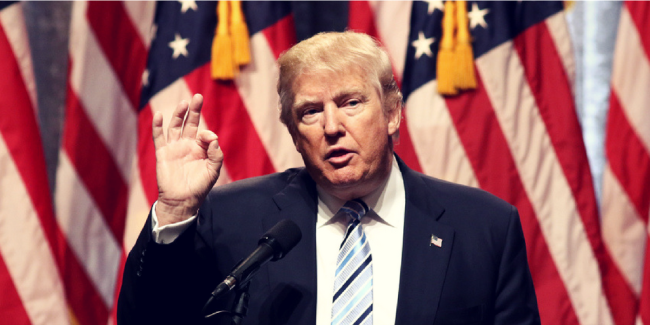
Europe needs better relations between Moscow and Washington. President-Elect Donald Trump spoke on the campaign trail of mending U.S. relations with Russia.

The "alt-right" votes for Trump
Donald Trump's xenophobic rethoric draws the support of white supremacists.
Trump et l'électorat populaire blanc
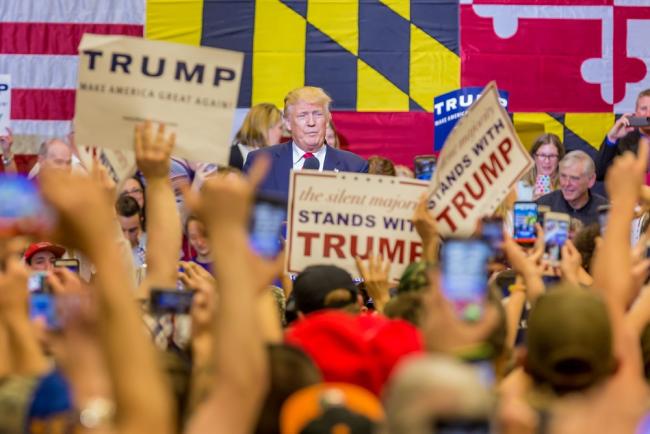
Donald Trump won the 2016 Republican primaries thanks to the mobilization of a specific part of the electorate: the white, non-college-educated, lower middle-class.

"Hillary Clinton's health is as much a problem as her credibility"
For Ifri's U.S. specialist, the Democratic presidential candidate's illness sheds a bright light not only on her health but also on her relationship to transparency.
Trump's Vice President: Attempting to heal the Republican rift
The announcement of Mike Pence as Republican presidential nominee Donald Trump’s running mate on July 15 was decidedly lackluster, if not downright awkward. Far from his normal persona of self-assurance to the point of hubris, Trump seemed uncomfortable and even nervous throughout, shifting plans and issuing contradictory statements in the days leading up to his running mate’s finalization.
As Pence’s name began to circulate last week, Trump signaled his malaise by insisting that the leaks were not a “final, final decision,” revealing his inability to confidently stick to Pence. Trump cancelled his first joint event with Pence scheduled for Friday, citing a desire to pay tribute to the victims of the attack in Nice, France the day prior; regardless, Trump drew attention back to himself and announced his choice on Friday evening anyway, via Twitter. Insiders reported that Trump sought assurance from advisors that Pence was the man for the job, even as Trump’s campaign fielded a last-minute appeal from New Jersey Governor Chris Christie.
The selection of Pence represents Trump committing himself to the Republican Party and its unification. Alliance building is Trump’s strategy, but drawing in Republicans is risky as it requires shunning others. A polarizing candidate is what Trump feels his campaign needs but comes with the unease of sacrificing his ability to say or do whatever he pleases, Trump’s characteristic trademark.
A facist America?
Are the United States at risk of giving into a totalitarian drift embodied by Donald Trump?
Présidentielles 2016: le Parti républicain et la politique étrangère
Three Republican presidential candidates have proposed a foreign policy agenda worthy of examination. Marco Rubio (who withdrew from the race on 15 March 2016) and Ted Cruz present well-defined political projects pertaining to different traditions of American foreign policy theory. Donald Trump’s approach is less clear-cut but also less traditional, between isolationism and profitability.
Ifri, a foundation recognized as being of public utility, relies largely on private donors – companies and individuals – to guarantee its sustainability and intellectual independence. Through their funding, donors help maintain the Institute's position among the world's leading think tanks. By benefiting from an internationally recognized network and expertise, donors refine their understanding of geopolitical risk and its consequences on global politics and the economy. In 2026, Ifri partners with over 90 French and international companies and organizations.
