



Between Russia and Europe, between War and Peace: What is at Stake in Armenia’s Upcoming Elections?
Armenia’s June 7, 2026, parliamentary election is shaping up less as a routine vote than as a referendum on Nikol Pashinyan’s post-2020 course, which includes peace with neighbors, reduced dependence on Russia, and a more explicit European orientation. The ruling Civil Contract party is still the frontrunner, but its position is fragile, as the campaign is being fought in a highly polarized environment shaped by the trauma of defeat in the war against Azerbaijan, the displacement of Karabakh Armenians, and the massive election interference from Russia.
Titre
Key Takeaways
The Armenian parliamentary elections on June 7, 2026, will take place against a backdrop of political tensions with Russia, as evidenced by the suspension of Armenia’s participation in the OSTC.
In recent years, Nikol Pashinyan’s government has pursued a pragmatic foreign policy, for instance by improving relations with Turkey: these elections will reveal the impact of this strategy on the Armenian people.
Among the eighteen different parties participating in the election, some share the current government’s European ambitions, but the three main opponents of Nikol Pashinyan are united by the idea of rebuilding relations with Russia.
The most likely outcome of this election is the re-election of Nikol Pashinyan. However, if one of the pro-Russian parties wins, the recent peace in the South Caucasus could be undermined.
The current election in Armenia is unprecedented, especially when it comes to external involvement. In the previous elections, there was a general understanding that whatever the outcome, it would be unlikely to change Armenia’s geopolitical orientation as a Russian ally. This time, the main contenders are the incumbent government, which advocates reducing dependence on Moscow and establishing a new quality of relations with the West, and the opposition that calls for a return to an alliance with Russia. World leaders have openly taken sides in this electoral battle: European leaders and the Trump administration have expressed their support for incumbent Nikol Pashinyan, while Moscow has thrown its support behind opposition leader, Russian-Armenian billionaire Samvel Karapetyan.
The upcoming election can be seen as a vote of confidence in incumbent Prime Minister (PM) Pashinyan’s foreign policy, focused on two priorities: “diversification” and the “peace agenda”. “Diversification” refers to Armenia’s attempt to distance itself from Russia and find new foreign policy partners. In recent years, Armenia has visibly moved away from its long-standing dependence on Russia in the area of security. Thus, Armenia has frozen its participation in the Collective Security Treaty Organization (CSTO) and has almost stopped arms procurement from Russia, purchasing military equipment from other countries, including India and France. Russian border guards have been asked to leave the checkpoints in Yerevan airport and on the Armenia-Iran border.
This shift has been driven by the collapse of confidence in Moscow as a security guarantor because of Moscow’s passive stance during successive existential crises facing Armenia in recent years (including the 44-day war in 2020, clashes on the Armenia-Azerbaijan border in September 2022, and Azerbaijan’s 2023 offensive, which led to the exodus of Karabakh Armenians). Russia’s passivity in these crises has triggered a negative shift in public attitudes toward Russia, a shift reflected by the incumbent government’s policy. However, this shift has not been completed: the Russian military base remains in Gyumri, and Russian border guards are still stationed along the Armenia-Turkey and Armenia-Iran borders (though not at the checkpoints). The Armenian government has been wary of completely alienating Russia.
“Diversification” also implies closer links with Europe. The European Political Community Summit in Yerevan in May, followed by the first European Union (EU)-Armenia summit, marked a symbolic and political milestone in the relationship. It also helped the Armenian government present Armenia as an active participant in European diplomacy. The summit also led to a crisis in relations with Russia, especially due to Ukraine’s president, Volodymyr Zelensky’s visit and the statements he made in Yerevan. At the same time, it is also clear that the goal of joining the European Union (EU), which was enshrined in legislation adopted by the Armenian parliament a year ago, remains a strategic priority at best, rather than a realistic short-term goal. Armenia remains a part of the Eurasian Economic Union (EEU), with key dependencies on Russia as an energy supplier and as an export market.
However, “diversification” is not only about Europe. Yerevan managed to simultaneously advance its relations with the Trump administration as well. The United States of America (USA) helped bring Armenia-Azerbaijan negotiations to a close with the signing of the August 2025 Washington Accords. The accords also include the creation of the so-called “Trump Route for International Peace and Prosperity” (TRIPP), which helped to resolve the remaining controversies between Azerbaijan and Armenia. This is a road that will connect Azerbaijan to its exclave, Nakhchivan, over Armenian territory and will be managed by a joint American-Armenian company. Armenia has been visited by the US Vice President and the Secretary of State, who promised lucrative contracts in the spheres of nuclear energy and AI technology. Recently, Donald Trump endorsed Nikol Pashinyan in a social media post. Armenia also seeks to reduce its dependence on Russia by widening its relations with the global South. Thus, India became an important partner in terms of arms procurement. Armenia’s neighbors, Iran and Georgia, remain a priority, and Yerevan is doing its best to make sure that its relations with the EU and the US do not affect its relations with these countries.
>>> Discover all of Ifri's news and analyses on Russia/Eurasia.

Available in:
Themes and regions
ISBN / ISSN
Share
This page contains only a summary of our work. If you would like to have access to all the information from our research on the subject, you can download the full version in PDF format.
Between Russia and Europe, between War and Peace: What is at Stake in Armenia’s Upcoming Elections?

Russia/Eurasia Center
Founded in 2005 within Ifri, the Russia/Eurasia Center conducts research and organizes debates on Russia, Eastern Europe, Central Asia, and the South Caucasus. Its goal is to understand and anticipate the evolution of this complex and rapidly changing geographical area in order to enrich public discourse in France and Europe and to assist in strategic, political, and economic decision-making.
The Plight of Russia’s Air Power in the Ukraine War: Drone-Driven Innovations and Transformation of Traditional Air Force
Since the start of the Ukraine War, Russian strategic guidelines on the application of air power—seen as the decisive instrument for achieving success in modern wars—have proven to be outdated, irrelevant and even self-defeating.
China in Kyrgyzstan and Tajikistan: From Economic Presence to a New Security Role
Over the past three decades, China’s influence in Central Asia has steadily expanded, but in the last three to five years this process has entered a markedly accelerated phase. Following 2022, Beijing effectively revised both its strategy and its operational approach toward the region.
Russia, the Palestinians and Gaza: Adjustments after October 7th
The Soviet Union (USSR), and subsequently the Russian Federation as its internationally recognized legal successor, has consistently sought to play a visible role in efforts to resolve the Israeli-Palestinian conflict.
Deathonomics: The Social, Political, and Economic Costs of War in Russia
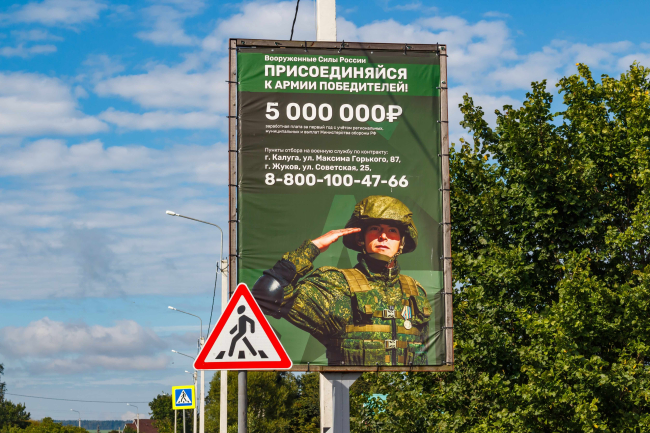
The report attempts to outline and examine a truly new phenomenon in Russian society, dubbed “deathonomics”—the making of a mercenary army against the backdrop of the Kremlin’s war in Ukraine, eventually replacing both the Soviet (conscript) and early new Russian (contract) armies. It notes that, by the end of 2023, this trend had turned the military service into one of the highest-paying professions in the country, something not seen in Russia on such a scale since the late 17th century.