



Australia’s Recognition of Palestine: A Case of Supporting the Status Quo over Accountability
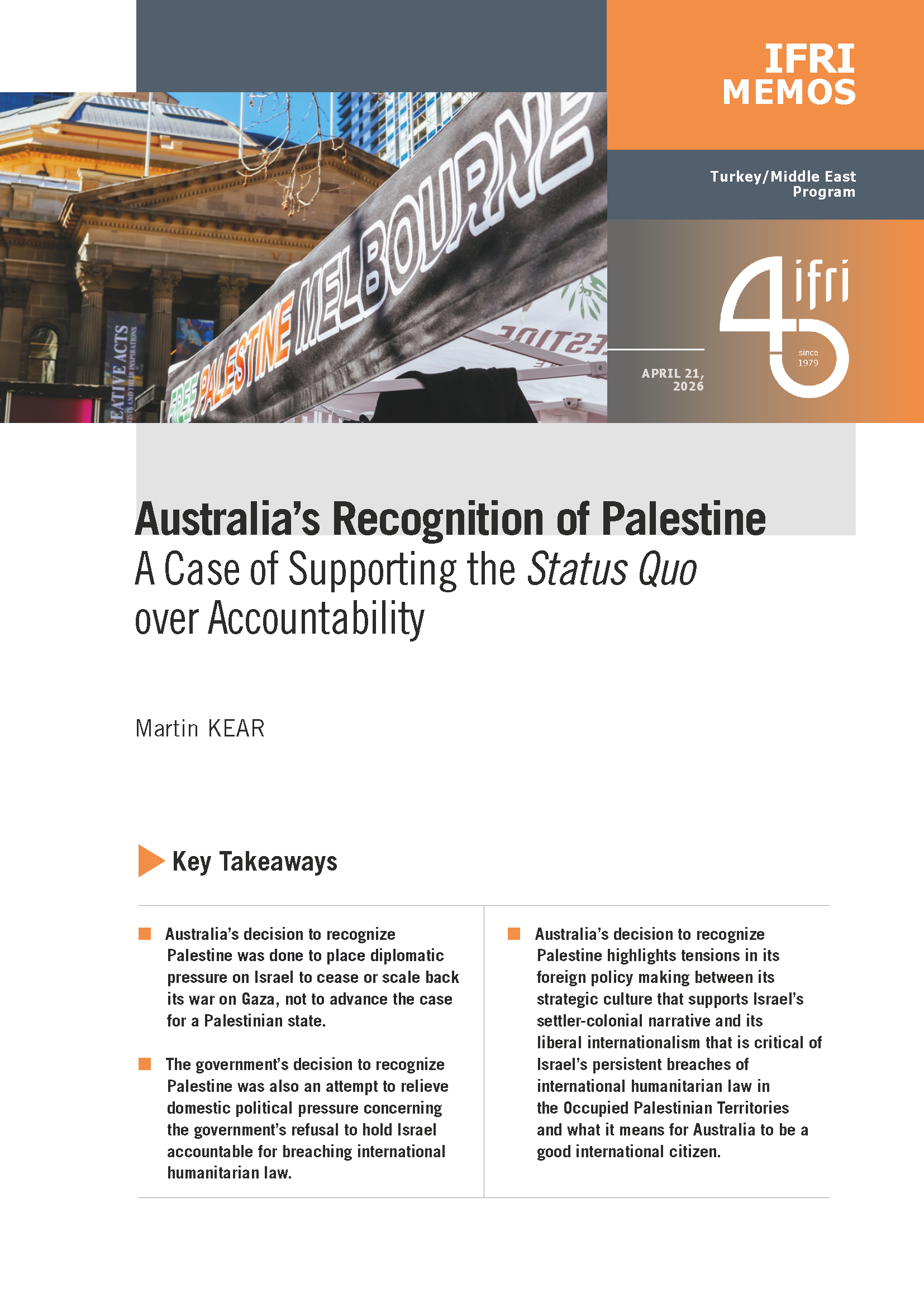
Hamas’s terrorist attacks against Israel on October 7, 2023, killed over a thousand Israelis, altering irrevocably the way the Palestinian/Israeli conflict is viewed internationally. Australia’s government professed profound shock and disgust at Hamas’s attacks, together with its unwavering diplomatic and political support for Israel. But as Israel’s response became more concerned with exacting revenge and as the pretext to fulfill long-held ideological dreams of a Greater Israel, support from Australia became more muted and conditional. This culminated in Australia joining Britain, France, and Canada in formally recognizing a Palestinian state at the United Nations General Assembly meeting in September 2025.
Titre
Key Takeaways
Australia’s decision to recognize Palestine was done to place diplomatic pressure on Israel to cease or scale back its war on Gaza, not to advance the case for a Palestinian state.
The government’s decision to recognize Palestine was also an attempt to relieve domestic political pressure concerning the government’s refusal to hold Israel accountable for breaching international humanitarian law.
Australia’s decision to recognize Palestine highlights tensions in its foreign policy making between its strategic culture that supports Israel’s settler-colonial narrative and its liberal internationalism that is critical of Israel’s persistent breaches of international humanitarian law in the Occupied Palestinian Territories and what it means for Australia to be a good international citizen.
The question is, how can we account for Australia’s apparent diplomatic U-turn? To answer this question, this paper places Australia’s recognition in a historical context, arguing that the government’s decision to recognize Palestine is a consequence of the interplay between Australia’s strategic culture and its liberal internationalism in determining what it means to be a “good international citizen” (GIC). Professor of International Relations Hakan Mehmetcik defines GIC as “a multidimensional concept that encompasses not only the actions of states, but also their motivations, commitments, and the broader ethical considerations that guide their behavior on the global stage.”
On one side of the debate over GIC stands Australia’s strategic culture. This is a distinct set of beliefs, attitudes, and practices concerning the use of force that arises through a unique and protracted historical process. This process reflects Australia’s Anglo-Saxon settler-colonial heritage and the corresponding need for great power patrons to protect its interests against potential foreign aggression. Therefore, Australia’s strategic culture prioritizes Israel’s continued security over Palestinian claims to statehood. Since Israel’s inception, Australia has followed the United States’ (US) foreign policy orthodoxy on the Palestinian/Israeli conflict that condones, appeases, and supports Israeli settler-colonial policies aimed at subjugating and pacifying Palestinians until they no longer pose a threat to the Israeli state. From this perspective, for Australia to consider itself a GIC, its foreign policy must be finely attuned to the strategic calculations of the US.
On the other side of the debate stands Australia’s adherence to a liberal international foreign policy framework that promotes diplomatic openness, sovereign equality, respect for human rights, and democratic accountability. This is reflected in Australia’s support for collective peacekeeping, the promotion of the rule of law, and support for the array of international institutions intended to resolve complex global problems. As Australia’s Foreign Minister, Penny Wong stated, “We want a world that is peaceful, stable, prosperous, and respectful of sovereignty. Where disputes are addressed in accordance with international law and norms, not by power and size.” From this perspective, for Australia to consider itself a GIC means not only acting in accordance with these tenets but refusing to accept/tolerate actions from other states that run contrary to them.
The interplay between these two concepts occasionally creates tension in Australian foreign policymaking because strategic culture favors maintaining the status quo, while maintaining liberal internationalist values requires vigilance and occasionally necessary change.

Available in:
Themes and regions
ISBN / ISSN
Share
This page contains only a summary of our work. If you would like to have access to all the information from our research on the subject, you can download the full version in PDF format.
Australia’s Recognition of Palestine: A Case of Supporting the Status Quo over Accountability


Turkey/Middle East Program
Ifri's Turkey/Middle East Program aims to provide expertise on the trends and developments in politics, societies and economies across the region.
The programme has the following objectives:
- Proposing a new approach towards the MENA region through an analysis of local, regional, and international dynamics with the potential to guide and influence new policies.
- Highlighting the role of foreign powers which have traditionally been present in the region and analyzing the new role taken on by emerging countries ;
- Anticipating new directions and outlooks in each country.
- Interpreting risks and potentials and putting forward new templates for analysis.
The programme has built a dense network of researchers and experts who provide expertise on the MENA region and working together on a range of crosscutting themes.
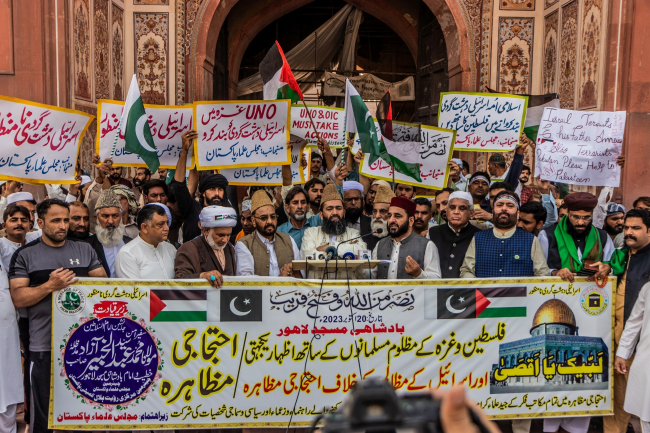
Pakistan and the Israel-Palestine Conflict: Transformation in Pakistan’s Approach After the War in Gaza
Pakistan has long combined vocal support for the Palestinian cause with covert engagement with Israel. Since the war in Gaza, this balance has become untenable: public opinion is united against Israel, joining Trump’s Board of Peace has drawn rare cross-party criticism, and new regional alignments put normalization out of reach.
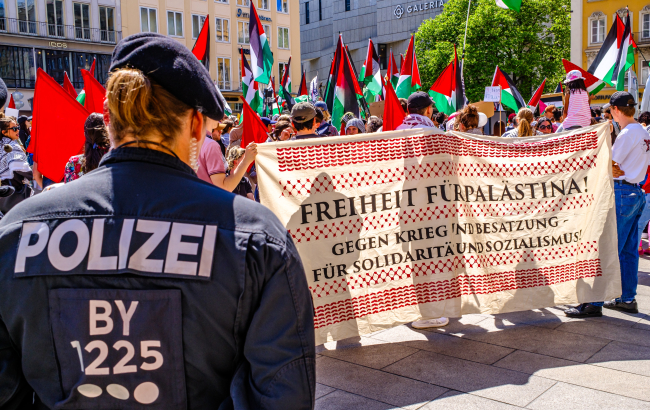
Overwhelmed: Germany’s Israel Policy after October 7th
Few countries have been as profoundly affected by the attacks of October 7th and the subsequent Gaza war as Germany. This is not merely a political controversy. It reflects a deeper structural problem: German-Israel policy has long rested on two guiding principles—a particular historical responsibility toward Israel derived from the Holocaust, and a firm commitment to universalist norms, above all international law and human rights.

Escalation within Continuity: Spain’s Foreign Policy towards Israel and Palestine after October 7th
Over the past two years, Spain has emerged as one of the most vocal countries in supporting the Palestinian cause. While Madrid initially aligned with the prevailing European position, recognizing Israel’s right to self-defense after the 7 October attacks, it soon distinguished itself from most European Union (EU) Member States by questioning and later condemning Israel’s conduct of war in Gaza.
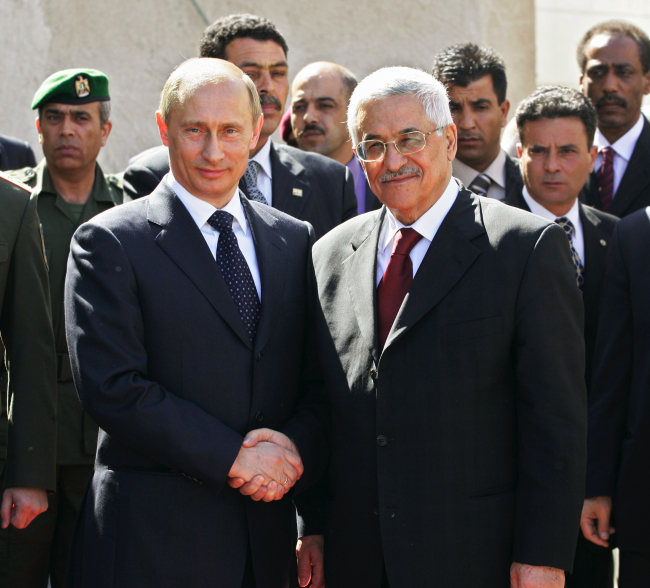
Russia, the Palestinians and Gaza: Adjustments after October 7th
The Soviet Union (USSR), and subsequently the Russian Federation as its internationally recognized legal successor, has consistently sought to play a visible role in efforts to resolve the Israeli-Palestinian conflict.