




Turkey
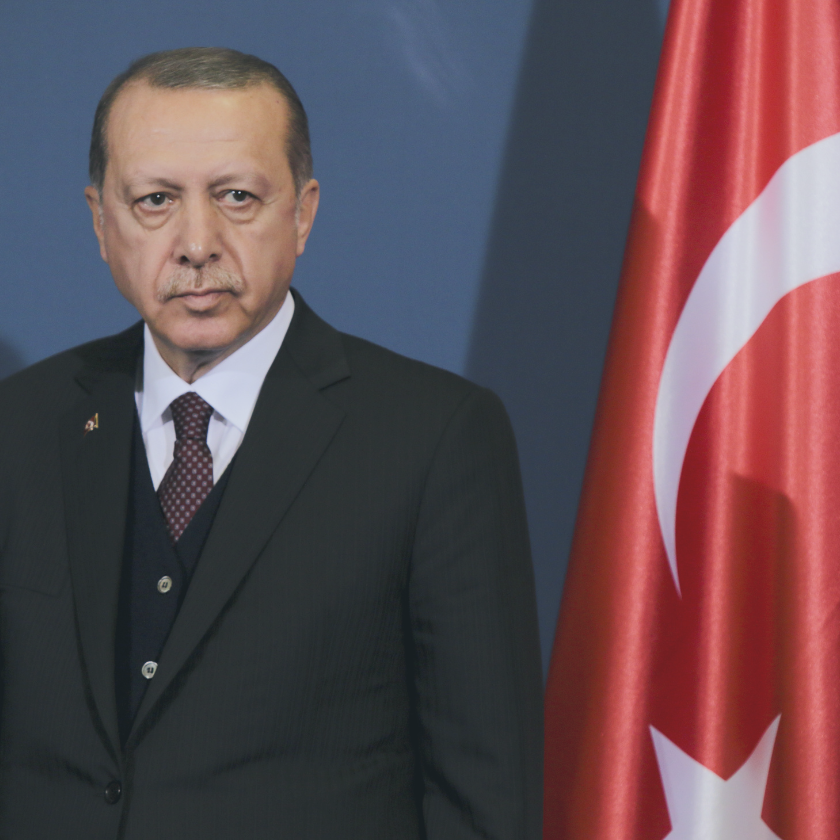
Analysis of Turkey's internal and external dynamics as a regional power, with a focus on diplomatic, economic and political issues linked to Recep Tayyip Erdoğan's third term in office.
Related Subjects
Trade without Religion between Turkey and Syria
A saying claims that trade has no religion; it even adapts to a war situation, as demonstrated by the real-time reorganisation of trade channels at the Turkish-Syrian border.


'Turkey Is Using Syria to Show its Strength - it's All About Image'
Turkey is looking to revive a fragile ceasefire in Aleppo, and the planned evacuation of civilians, which brokered with Russia. But why is Ankara, a staunch opponent of Damascus, interested in helping to create an outcome that would benefit President Assad? Amanda Morrow put the question to Dorothée Schmid, head of the Turkish studies programme at the French Institute of International Relations.
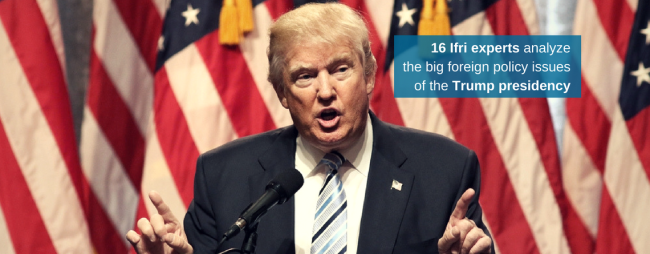
Le monde selon Trump. Anticiper la nouvelle politique étrangère américaine
What will become of US foreign policy under Donald Trump? A selection of Ifri researchers has come together to offer their thoughts on this question. Our experts cover an array of topics through 14 contributions, ranging from the future Sino-American relations, through US engagement in the Middle East, to the prospects of a renewed transatlantic relationship. This analysis intends to help readers anticipate the outcomes of this election in order to facilitate decision-making.
War and Democratic Decision Making: How do Democracies Argue and Decide Whether or Not to Intervene in Distant Wars?
What is the proper place and forum for decisions about war and peace in a democracy? There is surprisingly little consensus on this matter, not in theory and not in practice. While in Iraq, Libya and Syria, all Western actions have ended in failure, it seems necessary to analyze the place and importance of this aspect of the democratic decision making.
The Taboo of the Armenian Genocide, Part Two: The Politics of American Avoidance
The Armenian Genocide has been a topic of trials and tribulations in American politics for quite some time. It has been an issue in Presidential campaigns, like that of now-President Obama: when he promised to recognize it. It has been the topic of votes, such as the most recent 2010 vote which failed to recognize the genocide. It has been a funnel for interests, lobbying, and foreign investment. With Germany recently recognizing the genocide and an American Presidential election at hand, speculation of American recognition is once again at a high. As politicians debate the issue, or avoid it altogether, the American political system moves forward. There are various key players in American politics, but in specificity to the Armenian Genocide issue, there are the Armenian, Turkish, and Israeli lobbies, and the constituencies they represent.
The Taboo of the Armenian Genocide, Part One: Global Reaction and American Inaction
In the Syrian refugee crisis enveloping Europe, Turkey has become the bottleneck toward which migrants are flowing into Europe, a factor increasingly important for Germany in particular. Relations have been strained, however, due to disputes over the possibility of lifting visa requirements.
Kurds against IS: An Effective Military Solution?
The Kurdish military’s recent history immediately brings to mind images of its mythical female fighters, and of its real victories against Daesh. But its successes have been primarily in Syria. In Iraq, the Kurdish military has been hindered by poor preparation, lack of effective weaponry, and various political and tactical disagreements between actors. Without support from the West, Kurdish forces will not be able to win the on-ground offensive.
Turkey and the Armenian Genocide: from Denial to Recognition?
At the close of World War I, denial of the Armenian genocide became a central point in Turkey’s official doctrine.
Revisiting Relations 100 Years After the Armenian Genocide
The 100th anniversary of the Armenian genocide will not mark a great historical moment in Armenian-Turkish relations.
Russia’s New Energy Alliances: Mythology versus Reality
This brief paper analyzes the energy relations between Russia and its “new” energy partnerships – with China and Turkey – that the Kremlin tends to publicly promote as an alternative to energy relations with the West.
The Kurds: a Channel of Russian Influence in the Middle East?
With the Syrian crisis entering its fifth year, the changing security context in Syria and Iraq since the summer of 2014 has highlighted the increasingly important role played by the Kurds as a fighting force against Islamic State (IS). In a more general context of renewed Russian influence in the Middle East since the late 2000s, the development of Russo-Kurdish relations has entered a new phase since the beginning of the current decade.
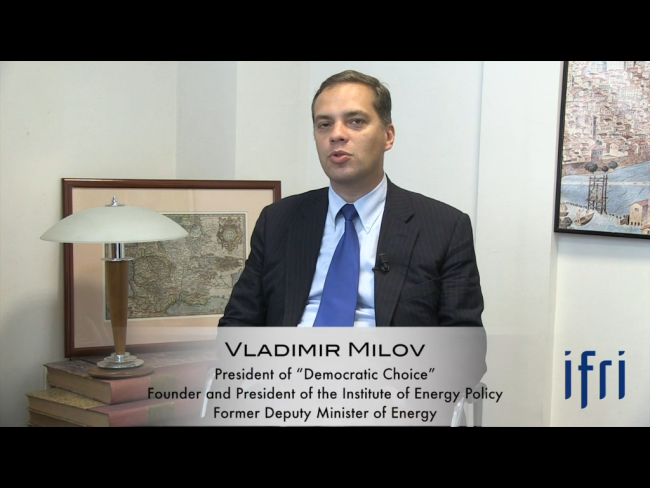
"Russia New Energy Alliances: Mythology versus Reality", Interview with Vladimir MILOV
"Past year has been marked not only with the Ukrainian crisis and unprecedented tensions in political relations between Russia and the West, but also with somewhat radical change of Moscow’s approach to international energy affairs. Widely promoted new energy partnerships with countries like China and Turkey were supposed to demonstrate that Russia has a choice of alternatives for mass-scale international energy cooperation, as compared to previous domination of European dimension, and if West wishes to cut ties with the Kremlin, Russia has somewhere else to go.
Does Russia really have an option of developing new international energy partnerships comparable in scale and significance to those with Europe as the consumer of energy, and with Western IOCs as key agents helping to secure further exploration and development of Russian oil & gas resources?"

Coalition or snap poll: What next for Turkey?
Turkish President Recep Tayyip Erdogan’s AKP suffered a stunning defeat in the latest parliamentary poll with the party losing its absolute majority for the first time in 13 years. The question now is whether it can hold on to power.
Israel and Hezbollah: The New Strategic Equation
After the war between Israel and Hezbollah during the summer of 2006, a deterrence strategy was established between the two parties. Occasional subsequent crises have thereby been contained and have been prevented from escalating into extensive confrontations.
Turkey: the Sèvres Syndrome, or the Endless War
For Turks, the Treaty of Sèvres symbolises the dissolution of the empire and the carving up of Turkey by foreign powers.
Syria: Ankara versus Tehran?
Turkish leaders would like to turn their country into the leader of the Middle East. However, they are in competition with another of the region’s key players: Iran.
What Kurdish Policy Will the JDP Adopt?
The emergence of an autonomous Iraqi Kurdistan, the civil war in Syria, and the electoral ambitions of the JDP (Justice and Development Party) have led to new policy being formed by the Turkish government regarding the Kurdish issue.
The Paradoxes of the Kurdish Spring in Syria
Although the Kurdish population in Syria forms a very small and highly divided minority, the Kurds nevertheless have managed, thanks to the civil war, to gain relative autonomy in Northern Syria.
Turkey: The Kurdish Movement in the “Peace Process”
While the peace process between the PKK (Kurdistan Workers’ Party) and the Turkish government is at a standstill, the latter is attempting to circumvent Turkey’s Kurdish actors by aligning itself with the KDP (Kurdistan Democratic Party), which dominates the Kurdish regional government in Iraq.
Ifri, a foundation recognized as being of public utility, relies largely on private donors – companies and individuals – to guarantee its sustainability and intellectual independence. Through their funding, donors help maintain the Institute's position among the world's leading think tanks. By benefiting from an internationally recognized network and expertise, donors refine their understanding of geopolitical risk and its consequences on global politics and the economy. In 2026, Ifri partners with over 90 French and international companies and organizations.

The Turkey 2050 Program develops a forward-looking analysis of the country to anticipate its dynamics over the next 30 years. The reflection is structured around three key themes:
• Domestic politics, to assess the stability of the AKP regime and the prospects for political change;
• The economy, to understand Turkey's capacity for recovery, the evolution of its production model, and its regional integration prospects;
• Foreign policy, to monitor the rise of Turkey's diplomacy and military capabilities, and to map the country's new spheres of influence.
This research, funded by companies and institutions active in Turkey, is based on field missions that aim to shed light on the blind spots and lesser-known areas of the Turkish landscape. Program partners benefit from personalized monitoring of relevant indicators to inform their decision-making, supported by monthly strategic briefings, sectoral reports, and access to a network of Turkish and French experts. The exchanges surrounding the program ultimately seek to define the concept of "Turkish risk" in a broad sense, in order to adapt our working methods accordingly.
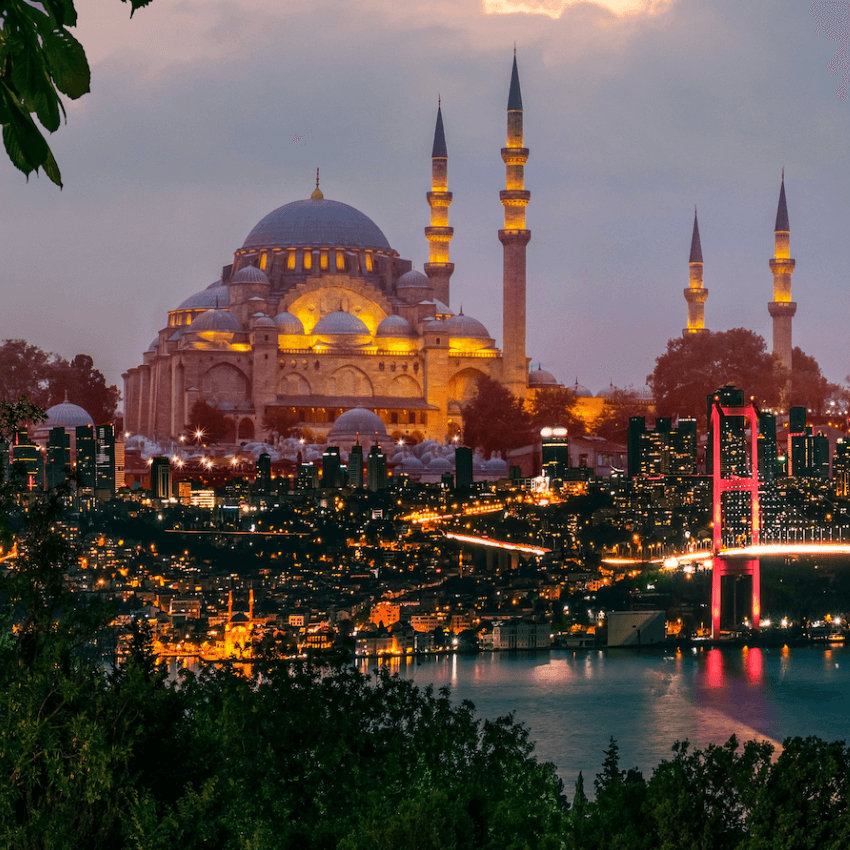
Ifri's Turkey/Middle East Program aims to provide expertise on the trends and developments in politics, societies and economies across the region.
The programme has the following objectives:
- Proposing a new approach towards the MENA region through an analysis of local, regional, and international dynamics with the potential to guide and influence new policies.
- Highlighting the role of foreign powers which have traditionally been present in the region and analyzing the new role taken on by emerging countries ;
- Anticipating new directions and outlooks in each country.
- Interpreting risks and potentials and putting forward new templates for analysis.
The programme has built a dense network of researchers and experts who provide expertise on the MENA region and working together on a range of crosscutting themes.