



The Future of Europe in the Context of Sino-American Competition

This special issue of Politique étrangère focuses on the proceedings of the Conference organized by the French Institute of International Relations (Ifri) for its 40th anniversary, held on April 10th, 2019, in Sorbonne University's Grand Amphithéâtre.
Resulting from deep changes brought to the Centre for Foreign Policy Studies, itself founded in 1935, Ifri emerged in an era we now consider as the beginning of the end of the old, Cold War world. In 1979, the Cold War was about to deal its final blow. While the Soviet Union was increasingly struggling to keep up with the US in the race for information technology, the downfall of the Gang of Four opened the way for economic development in China. 1979 was also shaped by revolution in Iran. The Islamic Republic rose from the ashes of the Pahlavi dynasty, marking the beginning of political Islam from a western perspective. At the time, in geopolitical circles however, (the word “geopolitics” was avoided because of its Nazi connotations) the expression “Third World” was still being used to designate underdeveloped countries. Its most ambitious representatives, such as India, Indonesia, and even Africa, dreamed of escaping the East-West bipolarity and endeavoured to achieve an ideology of non-alignment. In 1979, the European Economic Community (EEC) was still young, not even 25 years old. Great Britain had joined its ranks in an opportunistic move seven years previously, but the Community was still steered by the ideology of its founding states.
Forty years later, the international system has changed tremendously, even though the past has left its distinctive trace, as it always does. The system is once again tending towards bipolarity, without Russia this time, which has nonetheless managed to keep an important position on the international scene, particularly in Europe and the Middle East. The triumph of economic liberalism in the wake of the USSR's demise has radically altered development issues. The bond that kept the western ideology together is now crumbling before us, while the US has narrowed the scope of its national interest, a shift initiated before Donald Trump's election. Political Islam and terrorism have made their way into the spotlight. Since 2007, the scientist delusion that major economic crises were no longer possible has collapsed. The EEC, renamed European Union, sometimes seems to have lost its sense of origin and direction after all the shocks it has weathered, from economic ones to migratory ones to Brexit. The dizzying development of technology has kindled worry as much as hope, and millenarian fears are growing around climate change and other kinds of uncontrolled interdependency, like potential pandemics. Such was our world in 2019, the year Ifri celebrated its 40th anniversary. Then came the COVID-19 pandemic.We shall see whether it becomes the wake-up call that will allow the European Union to find its way back to its fundamental purpose. [...]
(Extract from the Foreword, by Thierry de Montbrial)
TABLE OF CONTENTS
The Future of Europe in the Context of Sino-American Competition - Foreword, by Bruno Le Maire
The World of Yesterday and Tomorrow, by Thierry de Montbrial
What Can Europe Hope to Achieve in Tomorrow's World?, with Franziska Brantner, Jean-Louis Bourlanges, Bernardino Leon, and Igor Yurgen
Europe and Africa, with Louise Mushikiwabo and Thierry de Montbrial
The Future of Europe from the US and Asian Point of View, with John Allen and Kishore Mahbubani
The Crucial Challenge of Cyberthreats, with Jean-Louis Gergorin and Thomas Gomart
The Future of Think Tanks, with Thomas Bagger, Thomas Gomart, Robin Niblett, and Daniela Schwarzer
Industry Response to New Protectionism, with Jean-Paul Agon and Patrick Pouyanné
New Global Challenges and European Security, with Julian King, Jean-Marie Guéhenno, Wolfgang Ischinger, Nathalie Tocci, and Hubert Védrine
The Future of Europe in the Context of Sino-American Competition - Conclusions, by Jean-Yves Le Drian
This special issue is also available in French: "L'avenir de l'Europe face à la compétition sino-américaine".

Available in:
Themes and regions
Share
This page contains only a summary of our work. If you would like to have access to all the information from our research on the subject, you can download the full version in PDF format.
The Future of Europe in the Context of Sino-American Competition

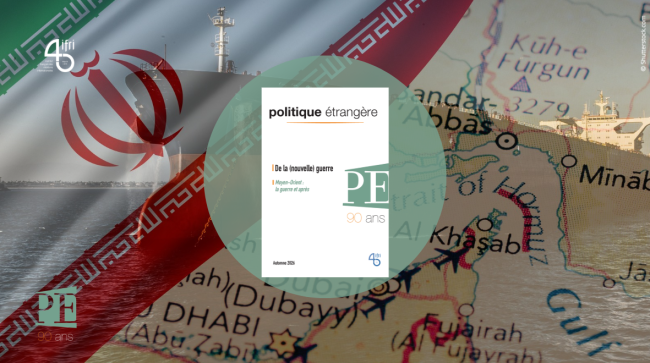
Iran: Anatomy of a Power at War
The elimination of Supreme Leader Ali Khamenei and several high-ranking officials at the outset of the 2026 American-Israeli operation did not succeed in bringing down the Iranian regime. The regime had prepared for such a scenario, notably by decentralizing its structures. Moreover, it continues to adapt to war. The power of the Islamic Revolutionary Guard Corps is growing at the expense of the Shiite clergy. The security apparatus defends the country’s sovereignty and justifies its actions in the name of raison d’état.
“Remodeling” the Middle East?
Chaos continues to spread, seemingly without end, across the Middle East. The Israeli-American attack on Iran has resulted in a clear military and diplomatic failure, but it is paving the way for a regional realignment, the consequences of which remain uncertain. New regional groupings are taking shape, either centered around Israel or built on the prospect of coexistence with Tehran, alongside a decline in American influence and the marginalization of Europe, while China maintains a low-key presence.
Silicon Valley and War: Lessons from Ukraine
Over the course of international conflicts, and particularly in Ukraine, major tech companies have emerged as central actors. Initially subject to wartime maneuvering, they have since become decisive actors in their own right, privatizing a significant share of wartime exchanges, shaping the information flows of societies, and presenting themselves as providers of security. This situation raises important questions about states’ autonomy in making decisions and taking action.
Does Artificial Intelligence Change the Nature of War?
From Gaza to Ukraine and Iran, current conflicts are being shaped by the arrival of artificial intelligence and robots on the battlefield. The changes under way are so profound that humans risk rapidly losing control over entire aspects of the conduct of military operations. While these technological developments are altering the character of war, their impact on the very nature of war itself remains a matter of debate.