



Responding to China's Rise: Balancing Hard and Soft Power
Informations pratiques
Centres et programmes liés
Ceci est un événement réservé.
En savoir plus sur nos programmes de soutien15 June 2010
17h00 - 18h30
at
Conseil central de l'Economie (CCE)
19-21, Ave. de la Joyeuse Entrée
1040 Brussels, Belgium (Metro: Schuman)
Co-organized with the Centre Asie, Ifri and the German Marshall Fund of the United States,
this seminar welcomes:
Gary Schmitt
Resident Scholar and Director of Advanced Strategic Studies
at the American Enterprise Institute (AEI) in Washington, D.C. and
co-author and editor of The Rise of China: Essays on the Future Competition
and
Valérie Niquet
Maître de recherche à la Fondation pour la recherche stratégique (FRS),
sinologist, and expert on strategic affairs in Northeast Asia
Chaired by
Andrew Small
Transatlantic Fellow
German Marshall Fund of the United States
As China becomes the world's second largest economy, the need to protect its growing interests beyond its borders grows ever more pressing. For years China has espoused its desire for a multipolar world while simultaneously promoting the virtues of its "peaceful rise". As economic development no doubt transforms into economic, political and even military power, the strategic posture of the US and the positioning of European allies will have to adapt to the changing dynamics in Asia. How should the West respond to the strategic implications of China's rise? This first seminar in a series of conversations meant to stimulate transatlantic dialogue on security concerns in Asia aims to present the views of American and European experts in an attempt to better understand competing perspectives and the issues at stake.
Autres événements

La sécurité environnementale : nouvel enjeu de l’autonomie stratégique européenne
Face aux bouleversements géopolitiques, à l’accélération du changement climatique et aux avancées technologiques qui redessinent les rapports de force mondiaux, la maîtrise des ressources s’impose comme un enjeu de puissance. Eau, énergie, matières premières critiques : des sujets longtemps appréhendés principalement sous l’angle environnemental ou économique occupent aujourd’hui une place croissante dans les réflexions sur la souveraineté et la sécurité des États.
Le renseignement peut-il encore anticiper les ruptures ?
Retour de la guerre de haute intensité en Europe, durcissement des rivalités entre puissances, multiplication des menaces hybrides, persistance du risque terroriste : le monde est entré dans une ère de confrontation où l'information, son contrôle et son exploitation sont devenus des armes à part entière.
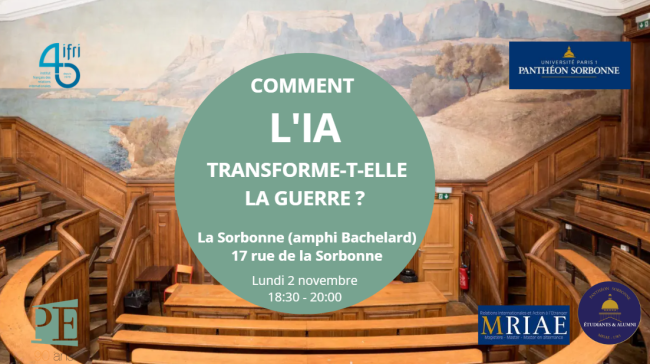
Comment l'IA transforme-t-elle la guerre ?
À l'occasion de la parution du numéro d'automne de Politique étrangère (n° 3/2026) et de son dossier sur les modalités de la "nouvelle" guerre, l'Ifri et l'Association (ADEA) du Magistère relations internationales et action à l'étranger (MRIAE) de la Sorbonne sont heureux de s'associer pour vous proposer une conférence autour de deux chercheurs de l’Ifri ayant contribué à ce dossier.