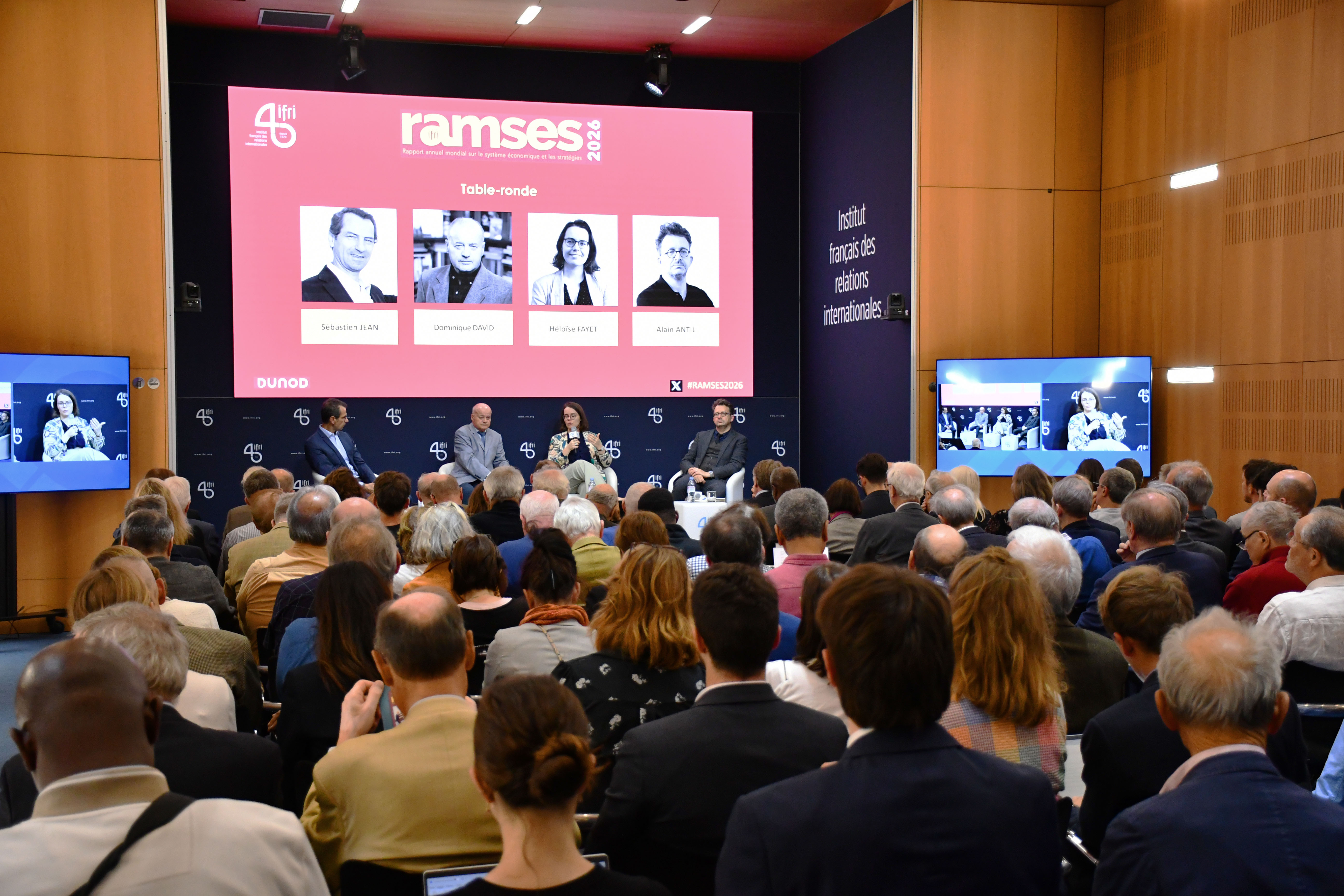
International Organizations and Multilateralism
Rhetoric on the crisis of multilateralism is frequent. International organizations (UN, WTO, etc.) remain no less important, while other forums (G20, BRICS, etc.) are asserting themselves.
Related Subjects
Is Africa's Recent Economic Growth Sustainable?
Hardly a week goes by without an African investors’ conference or growth summit.
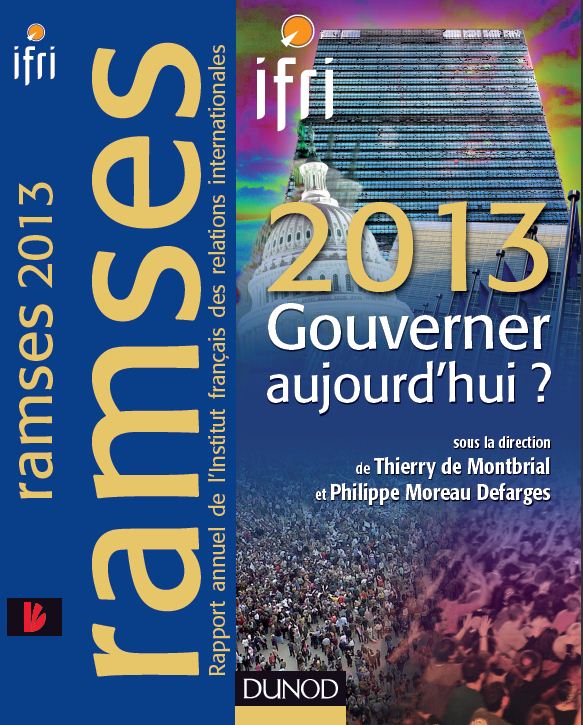
RAMSES 2013. Gouverner aujourd'hui ?
RAMSES (Le Rapport annuel mondial sur le système économique et les stratégies), is a yearly publication that provides in-depth reviews and prospective analysis on current events, providing readers with indispensable insights and perspectives for understanding contemporary geopolitics on the global scale. Edited by Thierry de Montbrial and Philippe Moreau Defarges, RAMSES relies on the expertise of Ifri’s research team and its network of associates.
Establishing the Rule of Law: the U.N. Challenge in Kosovo
Created on the 10th July 1999 by Security Council Resolution 1244, UNMIK was responsible for restructuring the institutions of a country devastated by war and establishing democratic governance. The security of people and goods and the existence of a legal system trusted by the population were two crucial prerequisites to the state-building process.
The Religious Diplomacy of the Russian Federation
The Russian Federation is shaping its religious diplomacy (i.e., in brief, the use of the religious factor in foreign policy) and exercises it with a growing efficiency. This is, to a certain degree, a consequence of processes taking place in Russia, namely, first and foremost, the solving of the crisis of identity and values, and, closely connected with this, the renaissance of religion in Russian political and social life.
Defence and Foreign Policy Under President-elect François Hollande
We know little about François Hollande's stance on wider foreign and defence policy issues. Though we are unlikely to see major changes from his predecessor, some clues from his successful campaign suggest that President-elect Hollande will adopt a more European and Gaullist approach.
Ukraine at the Crossroads: Between the EU DCFTA and Customs Union
After serious decline in the 1990s, Ukraine's economy finally started its recovery and systemic reform in early 2000. While the economy rapidly grew by 2008, its transformation remained unfinished. Ukraine has three possible roads to development.
South Africa and the Arab Spring: opportunities to match diplomacy goals and strategies
This paper highlights how the Arab Spring magnified a two-dimensional gap in South Africa’s foreign policy. First that South Africa does not have a vision which reconciles demands for achieving the goals of protecting human rights, sovereignty, and multilateralism; second, that its strategies do not meet set goals. The paper then provides tentative explanations to this gap. It ends by elaborating what in the “African Awakening” and in the midst of the Arab Spring are opportunities for South Africa to overcome this gap.
The Architect and Fragile States: Development Assistance's Contribution to Global Security
Up to Europe’s threshold in the middle of Sahara and Sahel region, a growing insecurity led beyond mere reconsideration of field practice to a whole change of paradigm for multilateral and bilateral aid institutions.
From 'Looking' to Engaging: India and East Asia
The Look East policy (LEP), launched in the early 1990s, was intended to engage India more closely with the East Asian region, but it met with only limited success initially, for India was not seen to be a major contributor either to regional security or economic development.
Political Europe: Is Hope Reasonable?
The European crisis is primarily the result of economic difficulties and their social effects.
IEA Crisis Management: Evolving with the Risks
Last week the IEA chose not to renew its June strategic stock release. It was the right decision. The volumes of strategic crude and product taken up by the market will be reaching refineries now and incremental volumes produced in the Arabian Gulf will be steaming towards markets.
A Look at the IEA 2011 Release of Strategic Oil Reserves
This paper examines the motivations and the potential consequences of the International Energy Agency’s coordinated action to release petroleum stocks on June 23, 2011.
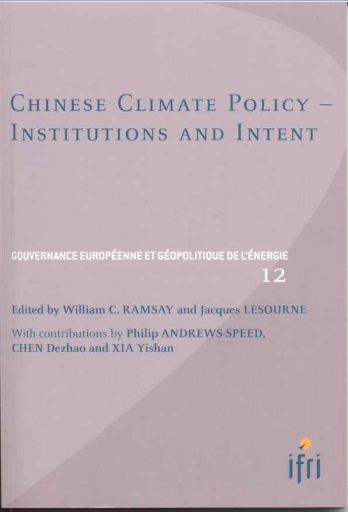
Chinese Climate Policy: Institutions and Intent
Until the late 1990s, the balance of Chinese energy production and consumption was treated by the rest of the world as a net figure. No one knew what was going on inside the Chinese economy - it was a black box. As far as anyone was concerned, the Chinese would not soon be a major factor in world energy markets.
Making Sense of One Health: Cooperating at the Human-Animal-Ecosystem Health Interface
This study aims at showing and making sense of the One Health approach, according to which it is impossible to defeat infectious disease without working at the interface between human health, animal health and the environment.
The G20 from Seoul to Cannes : Towards a Global Governance Committee
After two years of existence at the Heads of State and Government level, the Group of 20 (G20) has reached a turning point. In this new context, a number of questions need to be addressed-in particular, as to how to ensure the transition from a crisis management body to a global governance committee. How can the G20 solve the legitimacy problems inherent to its structure and nature? How can it address its representativeness deficit? What should be the exact mandate of the Group and how can this mandate be achieved?
The Governance of Energy Poverty in Southeastern Europe
This report presents the outcomes of a recently-completed research project1 aimed at uncovering the different ways in which energy poverty – understood as a condition wherein the domestic energy services available to a household are below socially and materially necessitated levels – is produced by, and mitigated through, the interaction of relevant decision-making institutions in the energy, social welfare, health and housing domains. The project focused on conditions in Southeastern Europe, where energy prices have been recently on the rise despite falling incomes and poor access to efficient and adequate energy services.
Obama's Diplomacy as Showcased by Web 2.0
Obama's administration is intent on restoring the US image abroad.
The G20 and the Challenge of International Financial Re-regulation
The crisis, it is now widely accepted, means that markets failed. Meeting for the first time in Washington in November 2008, the G20 embarked in a ride of re-regulation. Months of negotiations later, it dramatically appears different to agree on principles and broad objectives, and to write and enforce rules and commitments.
Global Governance of Biodiversity: New Perspectives on a Shared Challenge
This report aims to provide a first mapping of the global governance of biodiversity, through an investigation of the interactions between the various actors, institutions, norms, tools and processes that structure it. It chooses to do so by bringing together different visions or perceptions on the nature, shape and characteristics of the current global governance of biodiversity.
An Analysis of North Korea's Principal Trade Relations
The Direction of Trade Statistics by IMF is the most representative statistical data for bilateral trade with North Korea. However, IMF statistics underestimate North Korea's international trade since they do not classify inter-Korean trade as international trade. Therefore, this study restructures statistics on North Korea by combining the IMF and inter-Korean trade data, and it analyzes the structure of North Korea's international trade. In addition, it conducts a unique analysis of trade structures, since other studies have not analyzed production processes in North Korean trade.
This analysis identifies six main characteristics of North Korea's trade:
Ifri, a foundation recognized as being of public utility, relies largely on private donors – companies and individuals – to guarantee its sustainability and intellectual independence. Through their funding, donors help maintain the Institute's position among the world's leading think tanks. By benefiting from an internationally recognized network and expertise, donors refine their understanding of geopolitical risk and its consequences on global politics and the economy. In 2026, Ifri partners with over 90 French and international companies and organizations.