






Informations pratiques
Thématiques et régions
Centres et programmes liés
Ceci est un événement réservé.
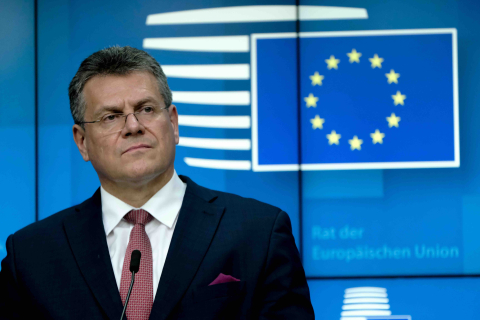
En savoir plus sur nos programmes de soutienDans le cadre de l'Ifri Energy Breakfast Roundtable, un séminaire avec la participation de Yurdakul Yigitgüden, ancien Sous-secrétaire d'Etat au Ministère turc de l'Energie, Elshad Nassirov, Vice-Président, SOCAR (tbc) et Brendan Devlin, administrateur principal, DG TREN, Commission européenne.
Discutant : Christof van Agt, chercheur, Clingendael International Energy Program.
Modérateur : William C. Ramsay, directeur du programme Energie à l'Ifri.
En collaboration avec le "Cligendael International Energy Programme" - http://www.clingendael.nl/
The pipeline projects in the Southern Gas Corridor have been extensively discussed inside and outside the EU. After the different high-level summits in April and May, what is the current state of the several pipeline projects in the Southern Gas Corridor? In the context of the Southern Gas Corridor, the position of Turkey as a transit country is crucial. Where are the negotiations on a transit regime going? What are the remaining obstacles to finding a solution acceptable to all parties involved?
Moreover, Azerbaijan as a potential supplier country is of uppermost importance for all pipeline projects in the Southern Gas Corrido and already makes an important contribution to the security of oil and gas markets. What lessons can be learnt and how is the position of Azerbaijan evolving in the context of current development in the region?
This meeting further develops on the outcomes & findings of earlier roundtable discussions held by the Energy Program of Ifri and the Clingendael International Energy Program, like most recently Ifri's Annual Conference "Investing in Europe's Energy Future" in Brussels or Clingendael's "Energy in SE-Europe" conference in the Hague.
|
|
Replay
Sujets liés
Autres événements

La sécurité environnementale : nouvel enjeu de l’autonomie stratégique européenne
Face aux bouleversements géopolitiques, à l’accélération du changement climatique et aux avancées technologiques qui redessinent les rapports de force mondiaux, la maîtrise des ressources s’impose comme un enjeu de puissance. Eau, énergie, matières premières critiques : des sujets longtemps appréhendés principalement sous l’angle environnemental ou économique occupent aujourd’hui une place croissante dans les réflexions sur la souveraineté et la sécurité des États.
Le renseignement peut-il encore anticiper les ruptures ?
Retour de la guerre de haute intensité en Europe, durcissement des rivalités entre puissances, multiplication des menaces hybrides, persistance du risque terroriste : le monde est entré dans une ère de confrontation où l'information, son contrôle et son exploitation sont devenus des armes à part entière.
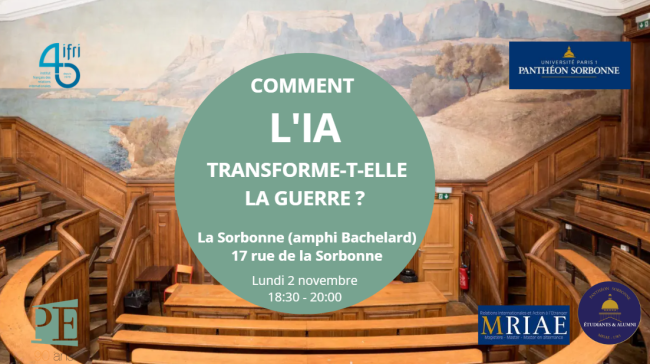
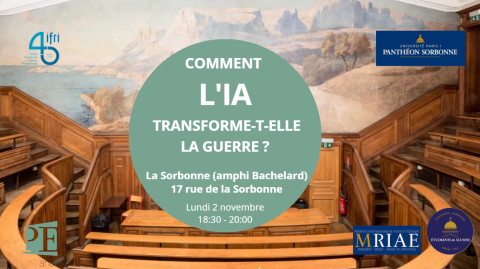
Comment l'IA transforme-t-elle la guerre ?
À l'occasion de la parution du numéro d'automne de Politique étrangère (n° 3/2026) et de son dossier sur les modalités de la "nouvelle" guerre, l'Ifri et l'Association (ADEA) du Magistère relations internationales et action à l'étranger (MRIAE) de la Sorbonne sont heureux de s'associer pour vous proposer une conférence autour de deux chercheurs de l’Ifri ayant contribué à ce dossier.