

The Culture of Remembrance in Tunisia
Contribution Blog "Shaping the humanities"
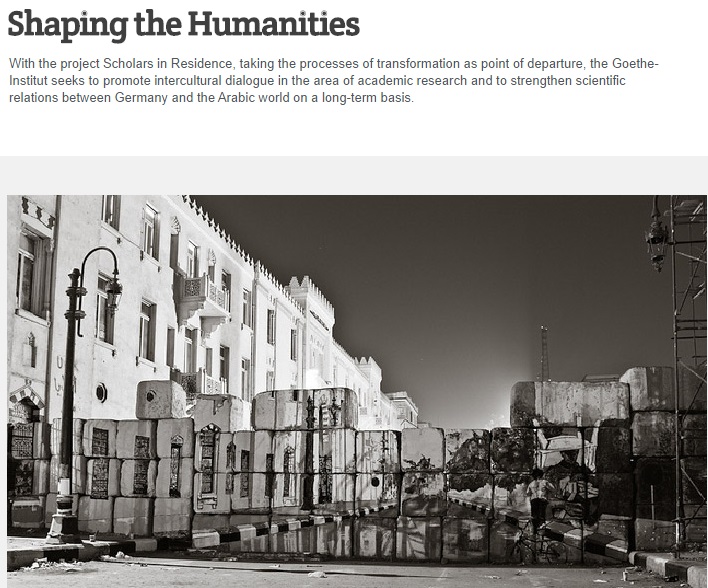
Coming to terms with the past through the opening of former places of terror
The culture of remembrance can be consolidated only by the creation of publicly accessible places of remembrance. In the same way, it is important to produce a relationship of trust between politics and civil society by transforming former places of terror into places of reconciliation. A welcome step was, for example, the “open house day” at the presidential palace, initiated by Moncef Marzouki.
http://blog.goethe.de/humanities/archives/36-The-Culture-of-Remembrance-in-Tunisia.html
With the project Scholars in Residence, taking the processes of transformation as point of departure, the Goethe-Institut seeks to promote intercultural dialogue in the area of academic research and to strengthen scientific relations between Germany and the Arabic world on a long-term basis.
Scholars in Residence is part of the German-Egyptian and German-Tunisian transformation partnership 2012-2013. The project is an initiative by the Goethe-Institut and being carried out in cooperation with the Institute for Advanced Studies in the Humanities (KWI) and the Ruhr University Bochum"s Centre of Mediterranean Studies (ZMS). Funded with special grants provided by the German Federal Foreign Office.

Contenu disponible en :
Régions et thématiques
Utilisation
Comment citer cette publicationPartager
Nele Katharina WISSMANN
Ancienne Chercheuse associée, Comité d'études des relations franco-allemandes (Cerfa)

Comité d'études des relations franco-allemandes (Cerfa)
Le Comité d'études des relations franco-allemandes (Cerfa) a été créé en 1954 par un accord intergouvernemental entre la République fédérale d’Allemagne et la France, afin de mieux faire connaître l'Allemagne en France et analyser les relations franco-allemandes y compris dans leurs dimensions européennes et internationales. Dans ses conférences et séminaires, qui réunissent experts, responsables politiques, hauts décideurs et représentants de la société civile des deux pays, le Cerfa développe le débat franco-allemand et suscite les propositions politiques. Il publie régulièrement des études à travers deux collections : les « Notes du Cerfa » et les « Visions franco-allemandes ».
Le Cerfa entretient des relations étroites avec le réseau des fondations et des think tanks allemands. En plus de ses activités de recherche et de débat, le Cerfa promeut l’émergence d’une nouvelle génération franco-allemande à travers des programmes de coopération originaux. C'est ainsi qu'en 2021-2022, le Cerfa a conduit un programme sur le multilatéralisme avec la Fondation Konrad Adenauer de Paris. Ce programme s'adresse à des jeunes professionnels des deux pays intéressés par les enjeux du multilatéralisme dans le contexte de leurs activités. Il a couvert une large gamme de thèmes relatifs au multilatéralisme, tel que le commerce international, la santé, les droits de l’homme et la migration, la non-prolifération et le désarmement. Auparavant, le Cerfa avait participé au dialogue d’avenir franco-allemand, co-piloté de 2007 à 2020 avec la Deutsche Gesellschaft für auswärtige Politik (DGAP) et soutenu par la Fondation Robert Bosch, ou encore le groupe Daniel Vernet (anciennement Groupe de réflexion franco-allemand) qui avait été fondé en 2014 à l’initiative de la Fondation Genshagen.
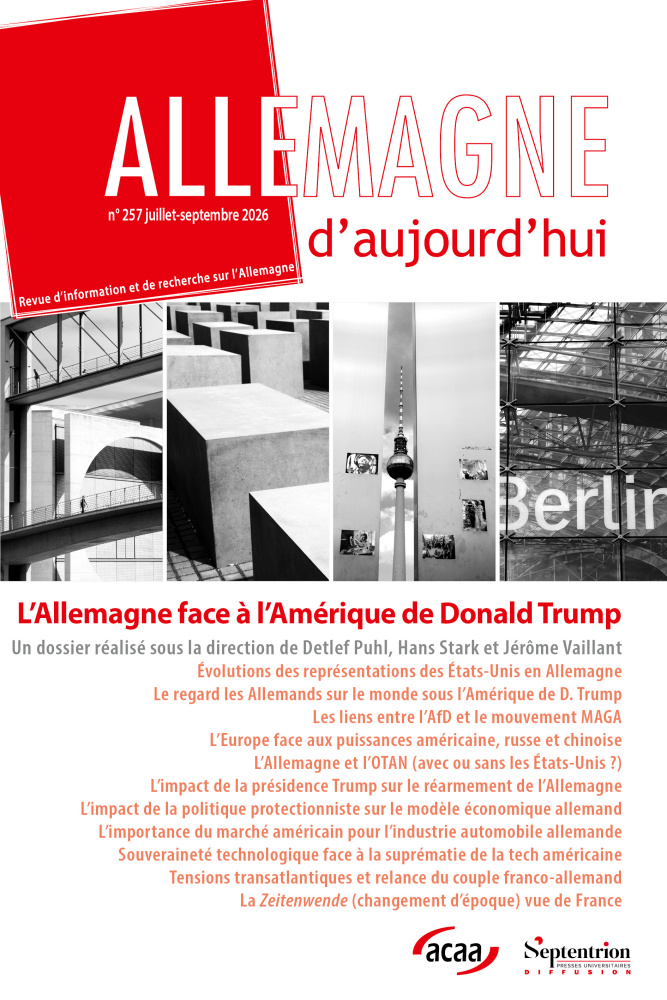
DOSSIER - Les relations germano-américaines à l’épreuve du second mandat Trump
Ce dossier aborde des questions fluctuantes vu les évolutions souvent erratiques du président américain et de son administration. Il tente pourtant de dégager les lignes de force de ces évolutions pour les faire mieux comprendre. À cette fin il fait appel à des spécialistes français et allemands des questions géopolitiques, politiques et économiques sans négliger la dimension historique pour contextualiser l’ensemble.
La relation franco-allemande au prisme du second mandat de Donald Trump : entre recompositions stratégiques, souveraineté européenne et permanence du lien transatlantique
Le retour de Donald Trump à la présidence des États-Unis en 2025 agit comme un puissant catalyseur de la relation franco-allemande. Face à l’incertitude croissante sur la fiabilité des garanties américaines, l’Allemagne, plus directement affectée par la remise en cause du lien transatlantique, se rapproche progressivement des positions françaises en faveur d’un renforcement de la souveraineté stratégique européenne.
MAGA et AfD : vers une alliance transatlantique des droites nationalistes
Le rapprochement entre le mouvement MAGA de Donald Trump et l’AfD allemande s’est fortement accéléré depuis le retour de Trump à la Maison-Blanche.
Volkswagen, Mercedes et BMW face à Donald Trump
L’industrie automobile allemande est confrontée à un triple défi : la concurrence chinoise ; une difficile transition vers le véhicule électrique ; et des droits de douane américains.