



China’s Stability at Risk: Economic, Social and Environmental Challenges

Informations pratiques
Centres et programmes liés
As economic jitters and environmental mismanagement are fueling social protest in China, this seminar will examine how these factors can eventually undermine economic and political stability in the country. Asian, European and American experts will gather to share their views on the economic, social and environmental challenges China is facing and what strategies are being adopted to tackle it.

9:00-9:15: Welcoming remarks
9:15-10:45: Assessing the Economic “New Normal” in China
Chair: Margit MOLNAR, Head of China Desk, OECD
"Diagnosing Chinese Economy"
Toshiya TSUGAMI, Tsugami Workshop
"China's Economic Strategies in Black Swan Lake"
Bo CHEN, Professor and Executive Director of FTZ - Huazhong University of Science and Technology
Olivier DE BOYSSON, Deputy Director and Chief Economist Emerging Economies, Société Générale (Discussant)
Françoise NICOLAS, Director, Center for Asian Studies, Ifri (Discussant)
11:00-12:30: Social and environmental tensions: how to ensure a stable China?
Chair: Françoise NICOLAS, Director, Center for Asian Studies, Ifri
"Re-conceptualizing China's civil society sector"
Andreas FULDA, Professor, The University of Nottingham:
"The Shifting Boundaries of Environmental Activism in China"
Elizabeth C. ECONOMY, C.V. Starr Senior Fellow and Director for Asia Studies, Council on Foreign Relations
“Urbanisation of Capital and Dispossession of Rights”
Hyun Bang SHIN, Associate Professor, London School of Economics (LSE)
“Three birds, one stone? China’s low-carbon transition as a catalyst for economic transformation, environmental sustainability, and social stability”
John SEAMAN, Research Fellow, Center for Asian Studies, Ifri
La conférence se tiendra en anglais
Autres événements

La sécurité écologique : nouvel enjeu de l’autonomie stratégique européenne
Face aux bouleversements géopolitiques, à l’accélération du changement climatique et aux avancées technologiques qui redessinent les rapports de force mondiaux, la maîtrise des ressources s’impose comme un enjeu de puissance. Eau, énergie, matières premières critiques : des sujets longtemps appréhendés principalement sous l’angle environnemental ou économique occupent aujourd’hui une place croissante dans les réflexions sur la souveraineté et la sécurité des États.
Le renseignement peut-il encore anticiper les ruptures ?
Retour de la guerre de haute intensité en Europe, durcissement des rivalités entre puissances, multiplication des menaces hybrides, persistance du risque terroriste : le monde est entré dans une ère de confrontation où l'information, son contrôle et son exploitation sont devenus des armes à part entière.
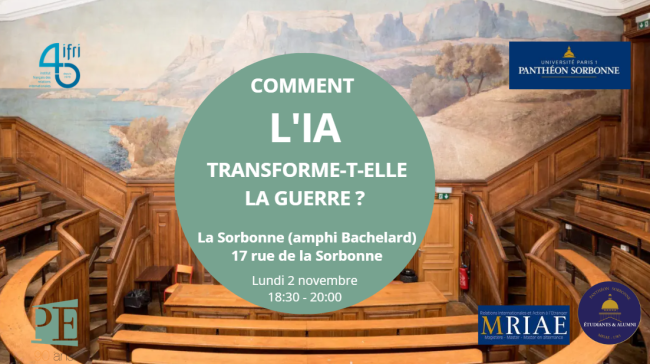
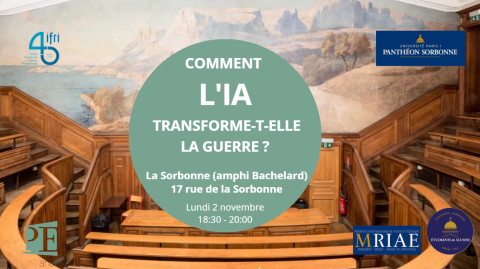
Comment l'IA transforme-t-elle la guerre ?
À l'occasion de la parution du numéro d'automne de Politique étrangère (n° 3/2026) et de son dossier sur les modalités de la "nouvelle" guerre, l'Ifri et l'Association (ADEA) du Magistère relations internationales et action à l'étranger (MRIAE) de la Sorbonne sont heureux de s'associer pour vous proposer une conférence autour de deux chercheurs de l’Ifri ayant contribué à ce dossier.