


Europe and the New Frontiers of Energy: Turning Grand Strategy into Effective Policy

Informations pratiques
Thématiques et régions
Centres et programmes liés
2015 Ifri Center for Energy Annual Conference, Brussels
#IfriEnergy
The Ifri Center for Energy will host its annual conference on March 4th, 2015 in Brussels. While global energy markets are transitioning to sustainable systems and are confronted by declining oil prices, there is a greater need to align European policies with global energy trends. This year’s theme, “New Energy Frontiers,” is aimed at calling for an outwards look on energy issues in the European Union as a way to create more realistic and stable policies. The discussion will revolve around the question of how the European energy and climate policies can deliver effective results in light of geopolitical upheavals, technological developments and governance issues.
Morning Session
8:30-9:00 Registration and welcome coffee
9:00-9:15 Welcome address, Thierry de MONTBRIAL, President of Ifri
9:15-9:45 Opening address, on behalf of the Latvian EU Council Presidency, Dzintars KAULINS, Head of Energy Division, Permanent Representation of Latvia to the EU
9:45-11:45 Session 1 - New Frontiers in Geopolitics: New Strategies for the Main Actors?
Chairman: Ambassador William RAMSAY, Former Deputy Executive Director, IEA, Senior Advisor, Ifri
"Saudi America", Mirage or Sustainable Reality? Sylvie CORNOT-GANDOLPHE, Associate Research Fellow, Ifri Center for Energy
Total and the New Energy Landscape, Yves-Louis DARRICARRERE, President Upstream of TOTAL
Unconventional Revolution and New Oil Price Environment, Olivier PERRIN, Associate Director, Schlumberger Business Consulting
Confrontation: Russia, Short-Sighted Politics or Long-Term Strategy? Tatiana MITROVA, Head of Oil and Gas Department, Energy Research Institute, Moscow
Tensions: Asian Power Games, Tatsuo MASUDA, Professor at Nagoya University of Commerce and Business, former Vice President of Japan National Oil Corporation
12:00-13:00 Special Debate: Energy Policy, Industry Policy: Hand-in-Hand or Face-to-Face?
Moderator: Barbara LEWIS, Senior EU Energy & Environment Correspondent, Reuters, Reuters
Dominique RISTORI, Director General, DG Energy, EU Commission and Jean-Pierre CLAMADIEU, President, European Chemical Industry Council (CEFIC)
13:00-14:00 Lunch
14:00-15:30 Session 2 - New Frontiers in Technology and Business: From Engineer’s Dream to Field Solutions
Chairman: Cécile MAISONNEUVE, Senior Advisor, Ifri Center for Energy
Renewables: How Much Does it Cost? Thomas-Olivier LEAUTIER, Professor, Toulouse School of Economics
Nuclear: a Legacy to Manage or Assets for the Transition? Jean-Pol PONCELET, Director General, FORATOM
Being an Energy Company Today: Mapping Moving Lanscapes, Susanne HOUNSELL, Associate Director, IHS Energy
Electricity Networks: Sharing the Burden, Dominique MAILLARD, Chief Executive Officer, RTE
15:30-15:45 Coffee Break
15:45-17:15 Session 3 - New Frontiers in Governance: Implementing Efficient Policies in Europe
Chairman: Marie-Claire AOUN, Director, Ifri Center for Energy
A Regulator’s View of the European Energy Policy, Lord MOGG, President of the Council of European Regulators, Chair of the Board of Regulators, ACER and European adviser, Ofgem
Implementing: A View from the Field (1), Jean-François CONIL-LACOSTE, Chief Executive Officer, EPEX SPOT
Implementing: A View from the Field (2), Denis SIMONNEAU, Member of the Executive Committee, GDF-SUEZ
Getting Ready for the COP in Paris
17:15-17-35 Paul WATKINSON, Head of the Climate Change Negotiations Team, France
17:35-17:45 Concluding Remarks with Marie-Claire AOUN, Director, Ifri Center for Energy
English/French translation available
Media Partner : 
Contact : Martine Breux: phone: +33 1 40 61 60 38 ; e-mail: [email protected]
Address: Hôtel THON EU, Rue de la Loi 75, B-1040 Brussels (metro Maalbeek)
Sujets liés
Autres événements
Le renseignement peut-il encore anticiper les ruptures ?
Retour de la guerre de haute intensité en Europe, durcissement des rivalités entre puissances, multiplication des menaces hybrides, persistance du risque terroriste : le monde est entré dans une ère de confrontation où l'information, son contrôle et son exploitation sont devenus des armes à part entière.
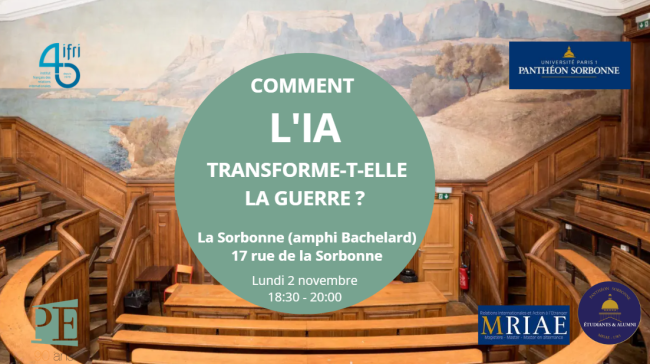
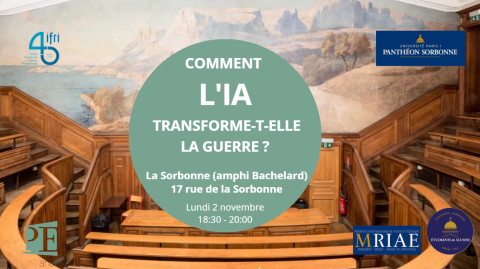
Comment l'IA transforme-t-elle la guerre ?
À l'occasion de la parution du numéro d'automne de Politique étrangère (n° 3/2026) et de son dossier sur les modalités de la "nouvelle" guerre, l'Ifri et l'Association (ADEA) du Magistère relations internationales et action à l'étranger (MRIAE) de la Sorbonne sont heureux de s'associer pour vous proposer une conférence autour de deux chercheurs de l’Ifri ayant contribué à ce dossier.
La COP31 à Antalaya : état de la gouvernance climatique mondiale, enjeux et perspectives
Les Conférences des Parties (COP) sont devenues un marathon de fin d’année visant à redynamiser un monde désormais entré dans l’ère du dépassement climatique. Alors que la Turquie affiche la plus grande production d’électricité carbonée parmi les pays de l’OCDE en Europe, elle a adopté le programme d’électrification et entend s'associer à l'Australie pour encourager la mise en œuvre de mesures concrètes. Il s'agit là d'un dispositif de coprésidence de facto inhabituel, mais qui pourrait donner des résultats prometteurs.