



Informations pratiques
Ceci est un événement réservé.
En savoir plus sur nos programmes de soutienThis one-day conference is jointly organized by Secure World Foundation (SWF) and the French Institute of International Relations (Ifri). It will examine how radio-frequency interference affects a variety of issues areas, including freedom of information (intentional interference, or "jamming"), telecommunication services (potential interference between systems sharing the C-band), and the governance of the geostationary arc (unintentional interference). It is part of a three year research program and a follow-up from a similar event that Ifri hosted in Paris in April 2013 and published about in a collective book released in January 2014. Join us to discuss this crucial issue with leading experts.

Voir la vidéo prise en marge de la conférence
Orbital Slots and Spectrum Use in an Era of Interference, par Ifri-podcast
8:30 Registration and coffee
9:00-9:15 – Welcome
Guilhem PENENT, Research Associate, Space Program, Ifri and Victoria SAMSON, Washington Office Director, SWF
9:15-11:15 – Panel 1: Interference and Freedom of Information
Media broadcasters and satellite operators continue to experience intentional interference on broadcast signals by some actors trying to prevent information to reach the public. In addition, as satellites begin to provide more telecommunication services such as internet access, they must deal with new pressure to control or manage the free flow of information. This session will examine the balance between freedom of information and national sovereignty across both of these issues.
Moderated by Guilhem PENENT, Research Associate, Ifri
Simon SPANSWICK, Chief Executive and founder director, Association for International Broadcasting (AIB)
Yasir HASSAN, Diector of Transmission Operations, Arabsat
Michel de ROSEN, Chairman and CEO, Eutelsat
Yvon HENRI, Chief of the Space Services Department (SSD) at the Radiocommunication Bureau, ITU.
Eanna O’CONGHAILE, Ireland’s representative at the Council of Europe’s Steering Committee on Media and Information Society (CDMSI) and member of the CDMSI Bureau
11:00-11:30 – Coffee break
11:30-13:00 – Panel 2: Interference and Telecommunication Services
A second area of concern is about existing and potential interference occurring as a result of mobile terrestrial services deploying into the frequencies which have been allocated to and used by the satellite industry. This panel will shed light on issues of sharing and compatibility between terrestrial and space systems using in particular the C-band. It will notably explore the regulatory, economic and industrial ramifications of this issue in the context of the upcoming WRC-15 conference.
Moderated by Aarti HOLLA-MAINI, Secretary General, ESOA
Nigel FRY, Head of Distribution BBC World Service Group
Cecil AMEIL, Senior Manager European Affairs, SES
Frank ZEPPENFELDT, European Space Agency (ESA)
13:00-13:30 – Keynote speech
Roberto VIOLA, Deputy Director General, DG Connect, European Commission
13:30-15:00 – Buffet lunch
15:00 -16:30 – Panel 3: Interference and the Governance of the Geostationary Arc
Unintentional non-voluntary interference remains the highest contributor to the number of events witnessed by satellite actors today. These are a consequence of the growing occupation and exploitation of the geostationary arc for which accommodation must be found between neighboring satellites and services in order to maintain its full potential. This panel will discuss the consequences of the arrival of new entrants on the so-called “rational” drive for more efficient use of the orbit/spectrum resource.
Moderated by Victoria SAMSON, Washington Office Director, SWF
François RANCY, Director of the ITU Radiocommunication Bureau
Gary L. THATCHER, Associate Director, United States International Broadcasting Bureau
Ron BUSCH, Chairman and Intelsat's Executive Director of the Space Data Association (SDA)
16:30-16h45 – Wrap up of the day
Richard ROITHNER, Director, Satcom, Euroconsult
Discussions will be held in English, without interpretation.
Due to limited spaces available, please be sure to register as early as possible
Lieu : Thon Hotel EU Brussels - 75 rue de la Loi - 1040 Brussels (metro : Maelbeek)
Organisateurs : Ifri Space Policy Program - contact: [email protected]
Sujets liés
Autres événements
Le renseignement peut-il encore anticiper les ruptures ?
Retour de la guerre de haute intensité en Europe, durcissement des rivalités entre puissances, multiplication des menaces hybrides, persistance du risque terroriste : le monde est entré dans une ère de confrontation où l'information, son contrôle et son exploitation sont devenus des armes à part entière.
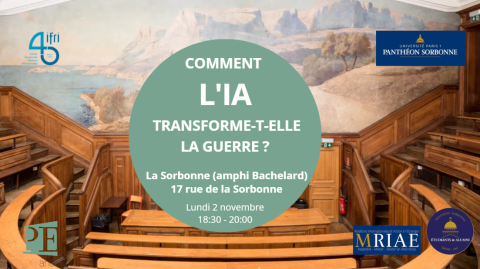
Comment l'IA transforme-t-elle la guerre ?
À l'occasion de la parution du numéro d'automne de Politique étrangère (n° 3/2026) et de son dossier sur les modalités de la "nouvelle" guerre, l'Ifri et l'Association (ADEA) du Magistère relations internationales et action à l'étranger (MRIAE) de la Sorbonne sont heureux de s'associer pour vous proposer une conférence autour de deux chercheurs de l’Ifri ayant contribué à ce dossier.
La COP31 à Antalaya : état de la gouvernance climatique mondiale, enjeux et perspectives
Les Conférences des Parties (COP) sont devenues un marathon de fin d’année visant à redynamiser un monde désormais entré dans l’ère du dépassement climatique. Alors que la Turquie affiche la plus grande production d’électricité carbonée parmi les pays de l’OCDE en Europe, elle a adopté le programme d’électrification et entend s'associer à l'Australie pour encourager la mise en œuvre de mesures concrètes. Il s'agit là d'un dispositif de coprésidence de facto inhabituel, mais qui pourrait donner des résultats prometteurs.